Tag: beauty

  • Survival of the Flittest

    A handwritten poem titled 'Survival of the Fittest' on a notebook page, discussing the relationship between machines and nature, featuring themes of power and beauty.
    Driving to work in a machine —
    (For a machine) that gives me power,
    And in other ways, takes my power;
    A machine tuned and perfected
    Over a hundred years;
    A machine upon which
    Cultures have fallen
    And cultures have formed —
    A red cardinal, tiny and fragile,
    Darted across the road
    In front of the machine
    That drives me.
    Panic pulsed through my heart.
    “No! I cannot, atop this other grief,
    Mourn the death of such beauty,
    Such life, to the machine.”
    All in a wingbeat
    With a twisting flit,
    Violent volitation,
    And agile ascension,
    The organism evaded the machine,
    And I held tight to some far off dream.
  • Storm Fronts and Jeremiads

    Storm Fronts and Jeremiads

    A few months ago, I began noticing extreme cloud changes. I’m sure they’ve always been there, but for the first thirty-five years of my life, I failed to see them.

    In the past year, though, I’ve seen and taken pictures of a few of these storm fronts.

    These abrupt changes strike me as beautiful. They also remind me of The Book of Jeremiah in The Old Testament.

    For most of the book, Jeremiah prophecies doom and gloom for Israel. He explains the terrible agonies the nation is experiencing because they’ve turned their backs on God.

    As I read the book, I kept thinking, “this is terrible. Is it ever gonna end?” Every page seemed to weigh a thousand pounds. I’d flip through and see that I had many pages to go.

    Then, around verse 16 of chapter 30, there is an abrupt change. Chapters 27-29 are entirely prose. Chapter 30 is almost entirely poetry.

    For the first half of chapter 30, the Lord recounts the pains of Israel.

    All your lovers have forgotten you;

    they care nothing for you;

    for I have dealt you the blow of an enemy,

    the punishment of a merciless foe,

    because your guilt is great,

    because your sins are flagrant.

    Why do you cry out over your hurt?

    Your pain is incurable.

    Because your guilt is great,

    because your sins are flagrant,

    I have done these things to you.

    (Jeremiah 30:14-15)

    But then, in verses 16 and 17, it all changes. It looks, to me, exactly like those sudden, drastic changes in the cloud formations.

    Therefore all who devour you shall be devoured,

    and all your foes, every one of them, shall go into captivity;

    those who plunder you shall be plundered,

    and all who prey on you I will make a prey.

    For I will restore health to you,

    and your wounds I will heal,

    declares the Lord,

    because they have called you an outcast:

    ‘It is Zion, for whom no one cares!’

    (Jeremiah 30:16-17)

    Thus says the Lord:

    Behold, I will restore the fortunes of the tents of Jacob

    and have compassion on his dwellings;

    the city shall be rebuilt on its mound,

    and the palace shall stand where it used to be.

    Out of them shall come songs of thanksgiving,

    and the voices of those who celebrate.

    I will multiply them, and they shall not be few;

    I will make them honored, and they shall not be small.

    (Jeremiah 30:18-19)

    Unfortunately, Jeremiah darkens again in the remaining chapters. The ending is not a happy one. Too, in the pictures of the cloud changes, the storm is as often coming as it is going. But those small moments in between, when everything is changing, leave us with awe. They remind us that, through clear skies and storms, something wonderful is happening.

  • The Beauty of Virtue

    Vice is a virtue these days. Indulgence, lavishness, and vanity are held up as some of the highest goods. Phrases like “retail therapy,” “guilty pleasure,” and “sex, drugs, and rock’n’roll” are almost viewed as positive values. On the other hand, virtue is seen as a drag. We hear, “go big or go home,” “nice guys finish last,” and “don’t be a buzzkill.”

    While there is an ounce of truth to each of these phrases, the bigger idea behind them—that virtue is a bummer or a bore or a waste of life—is a misconception. The truth is, virtue is beautiful, and it leads to the best possible life.

    Before we can see why virtue leads to a better life, we have to understand what virtue actually is—something ordered, proportioned, and aligned with reality, much like beauty itself.

    Let’s consider beauty. If you’ve ever used word processing software, you’re probably familiar with line justification. If you set the software to right-justify, all of the lines are lined up along the right side of the page. To justify lines on a page is to order them a certain way. In order for this to happen, there needs to be a boundary around the page—the margins—for the lines to be ordered against.

    These two attributes—borders and justification—go a long way in producing a beautiful representation of text on the page. In fact, these two attributes are important components of anything beautiful. Take a look at this lithograph, titled “The Good Shepherd,” by Gebhard Fugel.

    Most obviously, there is the rectangular boundary that makes up the outer edges of the image. All of the main elements within the border—Christ, the sheep, the clouds, etc—are justified in relation to both the border and to one another. When these elements are well-ordered, clearly defined, and proportional, the image is more beautiful. There is a certain balance, a certain uniformity, to the whole scene.

    The uniformity is not perfect, but this doesn’t diminish the beauty of the image. In fact, if the image was perfectly uniform, it would lack another important component of beauty: variety. According to Edgar Allan Poe, “the “Uniformity” is the principle: — the “Variety” is but the principle’s natural safeguard from self-destruction by excess of self.”

    These two central components of beauty—uniformity and variety—are aligned with the very nature of reality. Iain McGilchrist, considered by many to be one of the greatest neuroscientists and philosophers of our time, comes to a similar conclusion about the nature of reality as Poe does about the nature of beauty.

    In an extraordinary lecture, titled “Division and Union,” at Ralston University, McGilchrist explained that both division and union are important, and that it is “the business of the unfolding of the cosmos to make [distinction within sameness] grow and flourish—an eternal creative unfolding of generality into uniqueness. It’s what we mean by there being anything at all.”

    He used snowflakes as an example. “No two snowflakes have the same structure. But interestingly, each arm of the snowflake obeys the same pattern that each other arm of the six arms of the snowflake obey…They seem to me to be a beautiful example of beauty and complexity that give rise to things that are unified and unique, and yet have interesting parts that make them the whole that they are.”

    Photos by Wilson Alwyn Bentley.

    So, in beauty and in the very nature of the universe, there is uniformity and variety. These are determined, in large part, by the borders and justification of its components.

    Let’s look at justification again. The word, justification, comes from Late Latin iustificationem. It means, “administration of justice.” (https://www.etymonline.com/search?q=justification) We generally think of justice in terms of laws and the legal system. A judge serves justice. But on a deeper level, it is much like justification in word processing software.

    Justice, in the legal sense, means a boundary is set and enforced, a line is drawn in a place deemed fair or right. Justice in terms of beauty is, similarly, all about forming the boundaries of the materials in the right relationship to themselves and to other boundaries, giving them uniformity and variety. Think back to justification in word processing software. It’s all about lining things up a certain way, relative to specific boundaries.

    Ultimately, though, justice is not just a legal term or a component of a beautiful document. It is a virtue, a way of being in alignment with the true nature of reality.

    It is the virtue of justice that underlies all of these other fields we call justice. According to Aristotle, virtue is “the golden mean between two vices,” and “means doing the right thing, in relation to the right person, at the right time, to the right extent, in the right manner, and for the right purpose.”

    When Poe spoke of variety being the natural safeguard from uniformity’s self-destruction by excess of self, he was talking about a “golden mean between two vices.” Variety prevents uniformity from being excessively uniform, and uniformity prevents variety from being chaotic. These virtues compose beauty. Their excesses, which are vices, produce ugliness—disproportionality, injustice, disorder, etc.

    In the same way, the promotion of indulgence, lavishness, and vanity, as the highest goods is vicious. Indulgence is the excess of temperance (deprivation is its deficiency, the other end of the golden mean of temperance). Lavishness is an excess of spending and consuming (stinginess is its deficiency) while generosity is the mean. And vanity, in our culture, is the excess of self-worth (low self-esteem is its deficiency).

    On a surface level, indulgence sounds great. It means I get to eat all the ice cream I want. But in reality, it’s a shallow, unrealistic approach to consumption. Sure, limiting myself to one scoop of ice cream might feel restrictive in the moment, but the true buzzkill is the lethargy and health issues that follow excess. Temperance leads to a better, more beautiful life.

    To favor vice is really just to take a shallow view, to aim lower, to miss the bigger picture. It is to not understand the true values of things, or to understand them but still fail to put them in the right order. To live virtuously is to put things in their proper place just the way a painter does with strokes on a canvas. To live virtuously is to live beautifully.

    To do so, we must learn the nature of reality and align our actions with the highest values. Then, we are in a position to live our best lives. It’s time to stop settling for less. It’s time to raise ourselves beyond the limited ways of vice.

  • My Contribution to Journalism

    There’s a lot of journalism about the dark things. That’s important because we can’t be whole until we integrate what is in our shadows and we can’t integrate what is in our shadows until they are illuminated.

    But I have something else to report. This can be my contribution to journalism.

    There are beautiful walkways cloaked in fresh air. And as the sun sets, the clouds have turned pink and purple and orange at the same time. And there’s a sycamore tree that has seen more sameness than I ever will. And two fawns are having a bedtime snack in a field. And the air is cool, but not enough for a sweater. And the moon is half, and the color of half and half.

    Broadcasting from just north of Pittsburgh, Pennsylvania, I’m Joseph Kreydt. To all the dark places and to all the light, good night.

  • Poe on Poetry: The Poetic Principle

    Edgar Allen Poe’s two essays on poetry (The Poetic Principle and The Rationale of Verse) are a couple of my favorite essays of all time. He explains poetry in simple terms and showcases its beauty. Below are my favorite parts of The Poetic Principle.

    On the Length of a Poem

    “I hold that a long poem does not exist. I maintain that the phrase, “a long poem,” is simply a flat contradiction in terms.”

    “I need scarcely observe that a poem deserves its title only inasmuch as it excites, by elevating the soul. The value of the poem is in the ratio of this elevating excitement. But all excitements are, through a psychal necessity, transient. That degree of excitement which would entitle a poem to be so called at all, cannot be sustained throughout a composition of any great length. After the lapse of half an hour, at the very utmost, it flags — fails — a revulsion ensues — and then the poem is, in effect, and in fact, no longer such.”

    “On the other hand, it is clear that a poem may be improperly brief…A very short poem, while now and then producing a brilliant or vivid, never produces a profound or enduring effect. There must be the steady pressing down of the stamp upon the wax.”

    On the Object (Purpose/Goal) of Poetry

    Truth or Goodness as the Objects of Poetry

    “…we find [the bias toward epic-length poems] succeeded by a heresy too palpably false to be long tolerated, but one which, in the brief period it has already endured, may be said to have accomplished more in the corruption of our Poetical Literature than all its other enemies combined. I allude to the heresy of The Didactic. It has been assumed, tacitly and avowedly, directly and indirectly, that the ultimate object of all Poetry is Truth. Every poem, it is said, should inculcate a moral; and by this moral is the poetical merit of the work to be adjudged.”

    “With as deep a reverence for the True as ever inspired the bosom of man, I would nevertheless, limit, in some measure, its modes of inculcation…In enforcing a truth, we need severity rather than efflorescence of language. We must be simple, precise, terse. We must be cool, calm, unimpassioned. In a word, we must be in that mood which, as nearly as possible, is the exact converse of the poetical.”

    “Dividing the world of mind into its three most immediately obvious distinctions, we have the Pure Intellect, Taste, and the Moral Sense…Just as the Intellect concerns itself with Truth, so Taste informs us of the Beautiful while the Moral Sense is regardful of Duty. Of this latter, while Conscience teaches the obligation, and Reason the expediency, Taste contents herself with displaying the charms: — waging war upon Vice solely on the ground of her deformity — her disproportion — her animosity to the fitting, to the appropriate, to the harmonious — in a word, to Beauty.”

    Beauty as the Object of Poetry

    “An immortal instinct, deep within the spirit of man, is thus, plainly, a sense of the Beautiful…And just as the lily is repeated in the lake, or the eyes of Amaryllis in the mirror, so is the mere oral or written repetition of these forms, and sounds, and colors, and odors, and sentiments, a duplicate source of delight. But this mere repetition is not poetry. He who shall simply sing, with however glowing enthusiasm, or with however vivid a truth of description, of the sights, and sounds, and odors, and colors, and sentiments, which greet him in common with all mankind — he, I say, has yet failed to prove his divine title. There is still a something in the distance which he has been unable to attain. We have still a thirst unquenchable, to allay which he has not shown us the crystal springs. This thirst belongs to the immortality of Man. It is at once a consequence and an indication of his perennial existence. It is the desire of the moth for the star. It is no mere appreciation of the Beauty before us — but a wild effort to reach the Beauty above…And thus when by Poetry, —or when by Music, the most entrancing of the Poetic moods — we find ourselves melted into tears — we weep then — not as the Abbaté Gravina supposes — through excess of pleasure, but through a certain, petulant, impatient sorrow at our inability to grasp now, wholly, here on earth, at once and for ever, those divine and rapturous joys, of which through the poem, or through the music, we attain to but brief and indeterminate glimpses.”

    The Poetic Principle: The Struggle to Apprehend God’s Love

    “The struggle to apprehend the supernal Loveliness — this struggle, on the part of souls fittingly constituted — has given to the world all that which it (the world) has ever been enabled at once to understand and to feel as poetic.”

    Music as a Special Form of Poetry

    “The Poetic Sentiment, of course, may develop itself in various modes — in Painting, in Sculpture, in Architecture, in the Dance — very especially in Music — and very peculiarly, and with a wide field, in the composition position of the Landscape Garden. Our present theme, however, has regard only to its manifestation in words. And here let me speak briefly on the topic of rhythm. Contenting myself with the certainty that Music, in its various modes of metre, rhythm, and rhyme, is of so vast a moment in Poetry as never to be wisely rejected — is so vitally important an adjunct, that he is simply silly who declines its assistance, I will not now pause to maintain its absolute essentiality. It is in Music, perhaps, that the soul most nearly attains the great end for which, when inspired by the Poetic Sentiment, it struggles — the creation of supernal Beauty. It may be, indeed, that here this sublime end is, now and then, attained in fact. We are often made to feel, with a shivering delight, that from an earthly harp are stricken notes which cannot have been unfamiliar to the angels. And thus there can be little doubt that in the union of Poetry with Music in its popular sense, we shall find the widest field for the Poetic development. The old Bards and Minnesingers had advantages which we do not possess — and Thomas Moore, singing his own songs, was, in the most legitimate manner, perfecting them as poems.”

    Poetry Defined

    “To recapitulate, then: — I would define, in brief, the Poetry of words as The Rhythmical Creation of Beauty. Its sole arbiter is Taste. With the Intellect or with the Conscience, it has only collateral relations. Unless incidentally, it has no concern whatever either with Duty or with Truth.”

    Truth and Goodness as Components of a Poem

    “It by no means follows, however, that the incitements of Passion, or the precepts of Duty, or even the lessons of Truth, may not be introduced into a poem, and with advantage; for they may subserve, incidentally, in various ways, the general purposes of the work: — but the true artist will always contrive to tone them down in proper subjection to that Beautywhich is the atmosphere and the real essence of the poem.”

    On the Poetry of Thomas Moore (Catholic poet, but different person than Saint Thomas More)

    “Among the “Melodies” of Thomas Moore, is one whose distinguished character as a poem proper, seems to have been singularly left out of view. I allude to his lines beginning — “Come, rest in this bosom.” The intense energy of their expression is not surpassed by anything in Byron. There are two of the lines in which a sentiment is conveyed that embodies the all in all of the divine passion of Love — a sentiment which, perhaps, has found its echo in more, and in more passionate, human hearts than any other single sentiment ever embodied in words:”

    Come, rest in this bosom, my own stricken deer,

    Though the herd have fled from thee, thy home is still here;

    Here still is the smile, that no cloud can o’ercast,

    And a heart and a hand all thy own to the last.

    Oh! what was love made for, if ‘tis not the same

    Through joy and through torment, through glory and shame?

    I know not, I ask not, if guilt’s in that heart,

    I but know that I love thee, whatever thou art.

    Thou hast call’d me thy Angel in moments of bliss,

    And thy Angel I’ll be, ‘mid the horrors of this, —

    Through the furnace, unshrinking, thy steps to pursue,

    And shield thee, and save thee, — or perish there too!

    “It has been the fashion, of late days, to deny Moore Imagination, while granting him Fancy — a distinction originating with Coleridge — than whom no man more fully comprehended the great powers of Moore. The fact is, that the fancy of this poet so far predominates over all his other faculties, and over the fancy of all other men, as to have induced, very naturally, the idea that he is fanciful only. But never was there a greater mistake. Never was a grosser wrong done the fame of a true poet. In the compass of the English language I can call to mind no poem more profoundly — more wierdly [[weirdly]] imaginative, in the best sense, than the lines commencing — “I would I were by that dim lake” — which are the composition of Thomas Moore. I regret that I am unable to remember them.”

    Reiterating the Poetic Principle

    Definition of the Poetic Principle

    “Thus, although in a very cursory and imperfect manner, I have endeavored to convey to you my conception of the Poetic Principle. It has been my purpose to suggest that, while this Principle itself is, strictly and simply, the Human Aspiration for Supernal Beauty, the manifestation of the Principle is always found in an elevating excitement of the Soul — quite independent of that passion which is the intoxication of the Heart — or of that Truth which is the satisfaction of the Reason. For, in regard to Passion, alas! its tendency is to degrade, rather than to elevate the Soul. Love, on the contrary — Love — the true, the divine Eros — the Uranian, as distinguished from the Dionæan Venus — is unquestionably the purest and truest of all poetical themes. And in regard to Truth — if, to be sure, through the attainment of a truth, we are led to perceive a harmony where none was apparent before, we experience, at once, the true poetical effect — but this effect is referable to the harmony alone, and not in the least degree to the truth which merely served to render the harmony manifest.”

    Examples of the Poetic Principle

    “We shall reach, however, more immediately a distinct conception of what the true Poetry is, by mere reference to a few of the simple elements which induce in the Poet himself the true poetical effect He recognizes the ambrosia which nourishes his soul, in waving of the grain-fields — in the slanting of tall, Eastern trees — in the blue distance of mountains — in the grouping of clouds — in the twinkling of half-hidden brooks — in the gleaming of silver rivers — in the repose of sequestered lakes — in the star-mirroring depths of lonely wells. He perceives it in the songs of birds — in the harp of Æolus — in the sighing of the night-wind — in the repining voice of the forest — in the surf that complains to the shore — in the fresh breath of the woods — in the scent of the violet — in the voluptuous perfume of the hyacinth — in the suggestive odor that comes to him, at eventide, from far-distant, undiscovered islands, over dim oceans, illimitable and unexplored. He owns it in all noble thoughts — in all unworldly motives — in all holy impulses — in all chivalrous, generous, and self-sacrificing deeds. He feels it in the beauty of woman — in the grace of her step — in the lustre of her eye — in the melody of her voice — in her soft laughter — in her sigh — in the harmony of the rustling of her robes. He deeply feels it in her winning endearments — in her burning enthusiasms — in her gentle charities — in her meek and devotional endurances — but above all — ah, far above all — he kneels to it — he worships it in the faith, in the purity, in the strength, in the altogether divine majesty — of her love.”

  • Why I Deleted the Weather App from My Phone

    Why I Deleted the Weather App from My Phone

    I deleted the weather app from my phone. Then I got caught in a storm. But that was the point. I wanted to be surprised. I wanted to rebel against our modern tendency to control and predict everything.

    Prediction, especially if it’s accurate, gives us a sense of control over something by taking away its ability to surprise us. We try to love the wild, unpredictable world, but only on our own terms. We try to control what is not meant to be controlled. But true love and deep relationships, whether with a person or with nature, cannot exist under the weight of conditions and control. The myth of Davy Jones and Calypso (Pirates of the Caribbean) expresses this painful truth.

    Calypso, the goddess of the sea, and Davy Jones, a mortal sailor, fell in love.

    Calypso rewarded Davy Jones by giving him the sacred task of ferrying souls who died at sea to the world beyond. Jones agreed to set foot on dry land once every ten years. If the love between him and Calypso was true, his task would be complete.

    Calypso, like the seas, was fickle and unpredictable. After ten years, Jones went ashore, but she was not there. This meant Jones would have to ferry souls for another ten years. He refused.

    Years later, when Calypso was imprisoned, the lovers finally met again.

    Davy Jones approached her cell and said, “Ten years, I devoted to the duty you charged me. Ten years, I looked after those who died at sea, and finally, when we could be together again, you weren’t there. Why weren’t you there?”

    “It is my nature,” said Calypso. “Would you love me if I was anything but what I am?”

    As painful as her words are, they are beautifully honest. Only free things can be loved. Machines, things under our control, cannot. We can only truly love beings, and beings are unpredictable.

    If we refuse to love a person unless they’re predictable, we’ll never love them. People are inherently unpredictable. And to truly love someone is to love them as they are.

    True love is unconditional. The moment it becomes conditional, it ceases to be love, and instead becomes a transaction; I’ll give you my love only if you are predictable. True love is far greater. True love is given without any expectation of repayment or even the expectation that it will be accepted.

    While Davy Jones’s story is a cautionary tale about conditional love, the ultimate example of unconditional love can be found in Jesus Christ’s Passion. Christ gave his life to redeem the sins of humanity without any expectation that humanity would accept this redemption. We’re entirely free to deny it. He knew many would deny it, and gave it anyway.

    Davy Jones was the opposite. He ferried souls to the afterlife not as an unconditional gift to Calypso, but so that she would be with him. When she wasn’t there, he stopped ferrying souls. His “love” for her was closer to the love a client has for his prostitute. In other words, he didn’t love her. He was paying her for an intimate relationship by ferrying souls to the world beyond.

    While it’s definitely not cool that Calypso didn’t hold up her end of the agreement, it also was against her nature to make such an agreement in the first place. And if Davy Jones had truly loved her, he would have loved her true nature, not her as he wanted her to be.

    So, what does the weather have to do with all of this? Well, for one, we saw weather as fickle and unpredictable, like Calypso, until we developed meteorology. And like Davy Jones, we refused to accept the unpredictable nature of it. Instead of loving it as the living thing it was, we took away its ability to surprise us. We turned it into something that could not be loved.

    By forecasting the weather, on-demand, we can be inflexible and unrelated to it. If it’s going to be hot outside, we can plan to be in an air-conditioned room all day, ignoring the heat. We don’t need to adapt as much. We don’t need to be surprised by it. We can, to a large degree, disconnect from the weather as it truly is; wild, natural, beautiful.

    Of course, we can’t totally control the weather. We can’t make it rain. By avoiding the heat, we’re still reacting to the weather. But not as deeply, not as personally. We don’t have to go outside and look at the sky to guess if it might rain. We just look at some data on a screen.

    It’s a subtle change in the relationship. But relationships are everything, and subtle doesn’t mean negligible.

    There are different levels of relationship. One of the deepest levels is what sociologist Hartmut Rosa calls resonance. At its core, resonance is about the quality of our relationship with the world; whether with nature, other people, art, work, music, ideas, or even with ourselves. Resonance is a level of relationship that opens us to that sense of awe we feel when we really see a beautiful work of art or someone helping a neighbor in need.

    According to Rosa, when we resonate with something, it calls us. But if we control a thing, then we cannot be called by it. It can only do what we allow it to do, and so it can never surprise us. And if it can’t surprise us, it can’t call us, and then we can’t resonate with it. We can’t relate to it on that deeper level. Instead of relating like lovers, we relate transactionally, like Davy Jones and Calypso.

    Weather is a wild, living thing, but by constantly knowing what it’s about to do, we blind ourselves to its ability to surprise us the way a wild or living thing can. It’s a shallow way to relate to anything, but especially something as wonderful as the weather.

    That’s why I deleted the weather app from my phone. Not because I’ll never look at a forecast again, but because I want to deepen my relationship with the weather itself. I want to be surprised by it. I want to resonate with it.

    Davy Jones made the mistake of demanding certainty from something that was never meant to be certain. He only wanted love if he could predict its shape. But love, whether for a person or for the living world, is always given into mystery.

    Weather is like that. It’s wild, fickle, alive. To stand in its presence without trying to reduce it to a chart or a number is to allow wonder back in.

    We might get caught in storms, but we’ll also be caught by awe.

    That, I think, is the better forecast.

  • Beauty or Comfort? How a Conservatory Visit Changed My Perspective

    Beauty or Comfort? How a Conservatory Visit Changed My Perspective

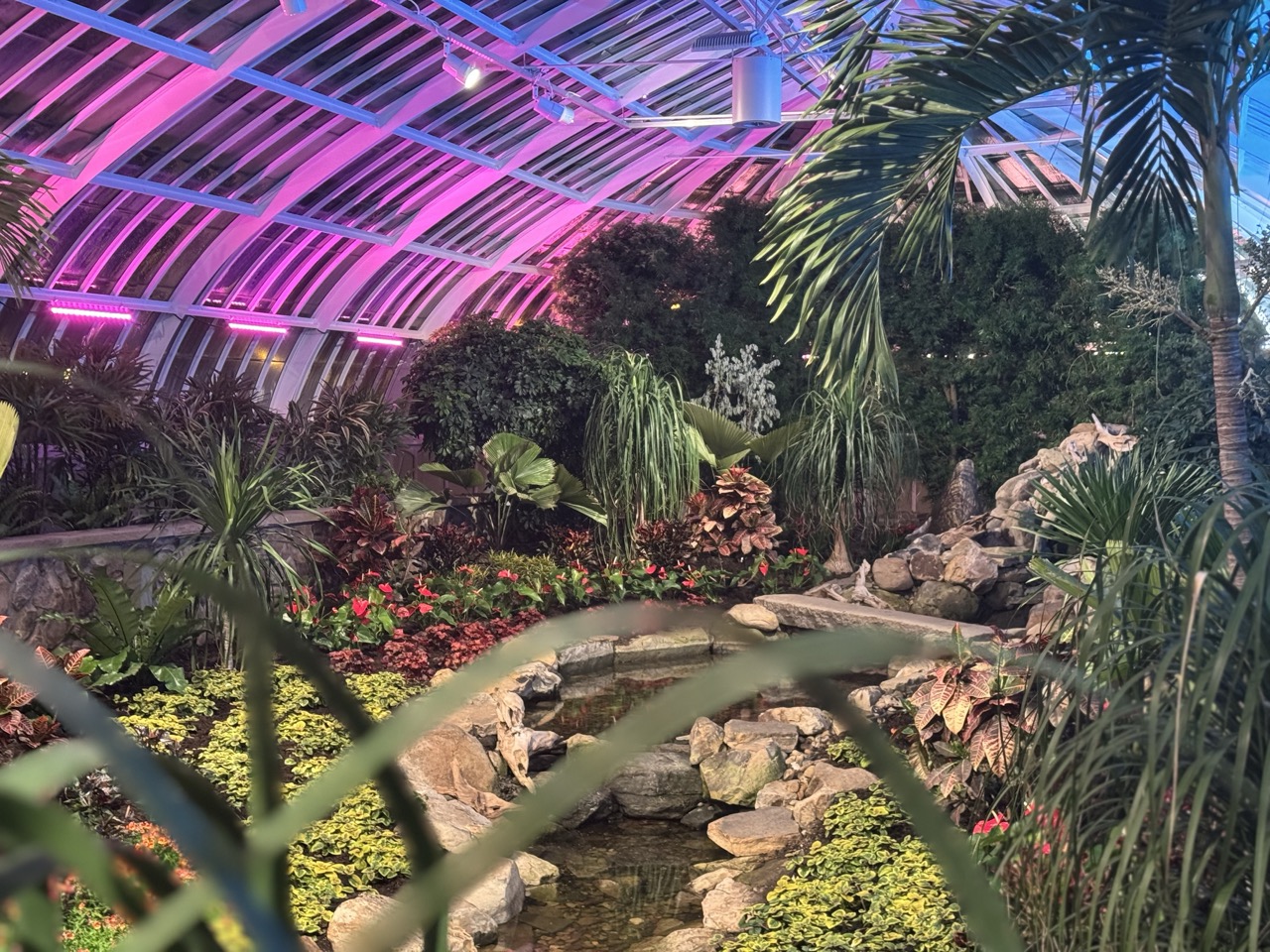
    A trip to Phipps Conservatory and the wonders of real world beauty.

    I almost stayed home last night. I almost spent the night in front of my laptop, being “productive.” My sister asked me to visit Phipps Conservatory. I said, “no.” But after the idea bounced around in my head for an hour or two, I changed my mind. After dinner, we ventured out into Phipps’ world of natural beauty and wonder.

    But first we had to get through brutally cold temperatures, winter’s darkness, and a little snow. Those discomforts initially deterred me. It seemed easier to keep hibernating. I’m glad I braved the winter weather because, well, the incredible beauty waiting inside was worth every shiver. Here’s a taste of what I was in for.

    Yet, if I had seen that picture before I went, it probably wouldn’t have swayed me. It’s a cool picture, but it doesn’t capture the incredible smells in each of the conservatory buildings. The one where trees were in bloom smelled like a spring day. The one full of ferns smelled like summer trips to my grandfather’s cabin. The air was fresh and light, a reminder that digital media simply cannot capture the fullness of such beauty.

    It makes me wonder if, by spending so much time in the digital world we are losing something important. Don’t get me wrong, I am a huge fan of the internet and cool productivity tools and connecting with old friends online. But there’s not much room there for real, tangible experiences, moments that fill life with awe and wonder. I must have said, “I wonder…” thirty times while my sister and I walked around the conservatory.

    The dessert room, with its strange cacti creeped me out a bit. I wonder what’s inside those big round ones.

    The intricate bonsai trees left me in awe. I wonder how many years the artist spent shaping such masterpieces.

    My sister said these orchids look like those jumping frog toys. To me, they look like alien spiders. I wonder what planet they came from.

    I wonder, when was the last time you stepped away from your screen to experience something real, something you could see, smell, or touch?

    For the past couple weeks, I had been hibernating, working on projects, working hard to become successful and wealthy, reading books and blog posts, watching YouTube videos, organizing my task lists and goals and bookmarks and files, listening to lo-fi music, and hibernating. And all that stuff is great. They even had lo-fi music playing at the conservatory too. It set the vibe nicely. And while no photo can replicate the smells and textures of real life, sharing this experience online reminds me how both worlds can intersect to inspire and connect.

    But, man, am I glad I ended up saying “yes” to visiting the conservatory with my sister. The real, tangible experience of beauty touches the soul in ways that bits and bytes cannot. Not only did the little trip refresh me, it reminded me why life is such a wonderful gift. It renewed my heart. It gave me a fresh perspective.

    I hope you have the opportunity to get out into the world and experience real beauty sometime, and soon. Maybe you can take a trip to a conservatory near you. Or maybe you can visit a museum. Or maybe, at least, you can go for a walk and pause for a moment to wonder, to let awe and curiosity renew your heart, just as it did mine.