Tag: Bible

  • Storm Fronts and Jeremiads

    Storm Fronts and Jeremiads

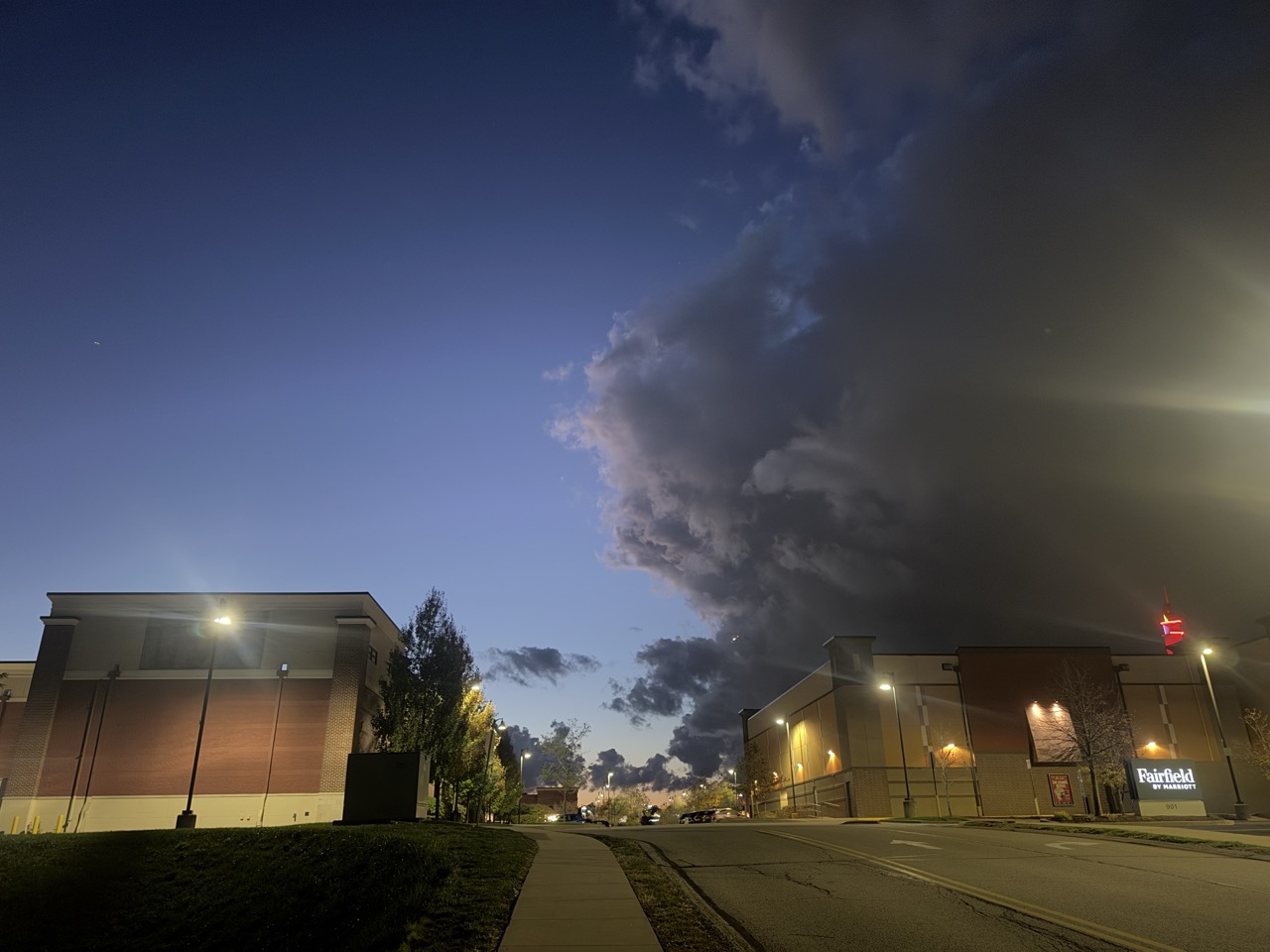
    A few months ago, I began noticing extreme cloud changes. I’m sure they’ve always been there, but for the first thirty-five years of my life, I failed to see them.

    In the past year, though, I’ve seen and taken pictures of a few of these storm fronts.

    These abrupt changes strike me as beautiful. They also remind me of The Book of Jeremiah in The Old Testament.

    For most of the book, Jeremiah prophecies doom and gloom for Israel. He explains the terrible agonies the nation is experiencing because they’ve turned their backs on God.

    As I read the book, I kept thinking, “this is terrible. Is it ever gonna end?” Every page seemed to weigh a thousand pounds. I’d flip through and see that I had many pages to go.

    Then, around verse 16 of chapter 30, there is an abrupt change. Chapters 27-29 are entirely prose. Chapter 30 is almost entirely poetry.

    For the first half of chapter 30, the Lord recounts the pains of Israel.

    All your lovers have forgotten you;

    they care nothing for you;

    for I have dealt you the blow of an enemy,

    the punishment of a merciless foe,

    because your guilt is great,

    because your sins are flagrant.

    Why do you cry out over your hurt?

    Your pain is incurable.

    Because your guilt is great,

    because your sins are flagrant,

    I have done these things to you.

    (Jeremiah 30:14-15)

    But then, in verses 16 and 17, it all changes. It looks, to me, exactly like those sudden, drastic changes in the cloud formations.

    Therefore all who devour you shall be devoured,

    and all your foes, every one of them, shall go into captivity;

    those who plunder you shall be plundered,

    and all who prey on you I will make a prey.

    For I will restore health to you,

    and your wounds I will heal,

    declares the Lord,

    because they have called you an outcast:

    ‘It is Zion, for whom no one cares!’

    (Jeremiah 30:16-17)

    Thus says the Lord:

    Behold, I will restore the fortunes of the tents of Jacob

    and have compassion on his dwellings;

    the city shall be rebuilt on its mound,

    and the palace shall stand where it used to be.

    Out of them shall come songs of thanksgiving,

    and the voices of those who celebrate.

    I will multiply them, and they shall not be few;

    I will make them honored, and they shall not be small.

    (Jeremiah 30:18-19)

    Unfortunately, Jeremiah darkens again in the remaining chapters. The ending is not a happy one. Too, in the pictures of the cloud changes, the storm is as often coming as it is going. But those small moments in between, when everything is changing, leave us with awe. They remind us that, through clear skies and storms, something wonderful is happening.

  • The Art of Wonder: Curiosity, Awe, and the Story of Job

    The Art of Wonder: Curiosity, Awe, and the Story of Job

    I’ve been wondering about wonder. It seems there are two parts to wonder. There’s the curiosity part: “I wonder how?” And then there’s the awe part: “How wonderful!”

    It’s possible that curiosity and awe are two distinct definitions of the word wonder, but I suspect they go hand in hand. If we aren’t curious, we’ll never look to see what’s around the corner. And we’ll never be awestruck by something we can’t see.

    You might suggest that, at times, we can experience wonder without looking for it, without curiosity. Sometimes it surprises us. That may be true. But I wonder if, by being curious, we might find it far more often. We might even find it in the most ordinary things, like steam rising from a mug or the pair of eyes we see every day in the mirror.

    The Old Testament story of Job gets into this matter. At the beginning of the story, his life is great. But then all sorts of terrible things happen to him. His children die, his wife curses him, his health plummets. It is then that he becomes curious. “Why is this happening to me?”

    However, Job takes his questioning too far. Instead of remaining curious about things, he demands answers.

    In contrast to his demand for answers, Job’s friends don’t ask questions at all. Instead, they tell him why these terrible things must have happened to him. They don’t wonder, they assume. They cling to simplistic explanations, ignoring the mystery and complexity of life.

    Between Job and his friends, we see two forces that destroy curiosity, and therefore wonder. Job’s experience of wonder is inhibited by his demand for answers. His friends’ experiences of wonder are inhibited by their assumptions.

    Curiosity, by contrast, is neither a demand for answers nor an assumption of the answers. It’s asking questions while remaining open to mystery. And it’s the mysterious things that leave us in awe. It’s the unknown that makes us wonder and leaves us with a feeling of wonder. Neither Job nor his friends seem to understand this.

    No matter. God replies to Job’s demands. But He doesn’t give him answers. He doesn’t tell him why terrible things have happened to him. Instead, He asks Job questions that Job cannot answer, questions he can only wonder at. Through some of the most beautiful poetry, God opens Job’s heart to the awesomeness of wonder.

    He asks, “Where were you when I founded the earth?”

    If Job wasn’t struck with wonder in that very moment, no problem. God had plenty more questions for Job to ponder. These are some of my favorites:

    “Or who shut in the sea with doors, when it burst forth from the womb; when I made clouds its garment, and thick darkness its swaddling band, and prescribed bounds for it, and set bars and doors, and said, ‘Thus far shall you come, and no farther, and here shall your proud waves be stayed’?”

    Chapter 38, Verses 8-11

    “Have you commanded the morning since your days began, and caused the dawn to know its place?”

    Chapter 38, Verse 12

    “Who has cleft a channel for the torrents of rain, and a way for the thunderbolt?”

    Chapter 38, Verse 25

    God’s answer is one big, beautiful poem that essentially says, “Wonder.” It says, you were not the one who gave everything in the universe its form, its boundaries, its place, its beauty. You are the one who has been given it as a gift. You cannot know all the answers. You can demand to know, you can pretend to know, or you can wonder. The path that opens your heart to the experience of beauty, reality, and goodness is wonder.

    So perhaps, by cultivating curiosity, we can open ourselves to awe. By asking questions without demanding answers, by being present to mystery, we might find wonder, even in the ordinary. We might find it in the similarity between the words pain and rain, or we might find it in a sprinkled donut. We might, like Job, be invited into a deeper understanding of life’s mysteries, not through explanations, but through the gift of wonder itself.